

Gordon Parks, Self-Portrait, 1941, gelatin silver impress, 50.8 × 40.64 cm (xx × 16 in.), Individual Collection. Courtesy of and copyright The Gordon Parks Foundation
How does Gordon Parks use photography to address inequities in the United States?
How practise Gordon Parks's images capture the intersections of art, race, class, and politics across the United States?
What practice photographs in full general—and Gordon Parks's photographs more than specifically—tell u.s. nearly the American Dream?
"A photographer can exist a storyteller. Images of feel captured on film, when put together like words, can weave tales of feeling and emotion equally bold as literature.… [Photographers] bring together fact and fiction, feel, imagination, and feelings in a visual dialogue that has enormous impact on how we observe and chronicle to the external world and our internal selves." —Philip Brookman, "Unlocked Doors: Gordon Parks at the Crossroads," Gordon Parks: Half By Autumn, 1997
What did you picture show while reading this quote? Consider where you meet photographs and images in your own life. What touch do they have on yous?
There is perhaps no individual who embodies the power of photography more than Gordon Parks. Photographer, poet, musician, storyteller, activist—Gordon Parks shaped the times in which he lived as much as he was shaped past them. Though his career equally a photographer spanned six decades, it is the period from 1940 to 1950, the focus of the exhibition Gordon Parks: The New Tide, Early Piece of work 1940–1950, that near significantly defined his point of view every bit an African American artist and documenter of American life at the dawn of the modernistic civil rights move.
In 1937, while working as a waiter on the North Coast Limited rider train, Parks saw magazines featuring Depression-era photographs—images like Dorothea Lange's Migrant agronomical worker's family, Nipomo, California that recorded the social and economic conditions of migrant farmers across the country. For Parks, images of grit bowl migrants reminded him of his own struggles and inspired him to purchase his first photographic camera, a life-changing decision. He afterwards recalled, "I was convinced of the power of a good motion picture."
During the first decade of his career, Parks, a self-taught photographer, captured the beauty, ability, and stature of Chicago socialite Marva Louis; the spirituality of churchgoers in Washington, DC; and portraits of prominent African Americans like Richard Wright and Marian Anderson. But he would as well use his camera to shine a light on the injustices faced by black Americans, showing the poverty, violence, and oppression that defined the decade from 1940 to 1950. In the midst of World War II, with the American war machine however segregated, photographs like Washington, D.C., Government charwoman (American Gothic) brand a bold argument about the disparities between the hope and realities of the American Dream. When given the adventure, Parks chose to "fight back" against the inequalities he witnessed; his choice of weapons was a camera.
The photographs in this image set speak to the power of Parks's phonation equally an artist. His images certainly serve as documents of specific moments in time; only individually and as a group they as well reveal humanity, implore empathy, pose questions, provoke outrage, and even inspire activism. Though taken decades agone, Parks's photographs capture individuals and represent issues and themes that still resonate deeply with u.s. today.
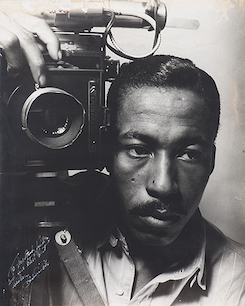
Gordon Parks Photography Gordon Parks, Cocky-Portrait, 1941, gelatin silver print, 50.8 × xl.64 cm (20 × 16 in.), Private Collection. Courtesy of and copyright The Gordon Parks Foundation
The youngest of 15 children, Gordon Parks was born in 1912 (d. 2006) in Fort Scott, Kansas. His parents had moved at that place from Tennessee in the years post-obit the post–Civil War Reconstruction menstruum. Although he was close with his supportive family unit, Parks could non ignore the inequality and racism around him. He recalls, "The indignities came so often that I presently began to accept them every bit normal. But I e'er fought dorsum."
Parks purchased his showtime camera in 1937 and committed himself to becoming a lensman. A consummate observer of the world, he plant inspiration in magazines, museums, and books. He began experimenting with portraiture and some of his photographs were featured in the local African American newspaper in Saint Paul, Minnesota. Though primarily cocky-taught, Parks's education was influenced past other artists and mentors he encountered in the early role of his career. He would proceed to accomplish extraordinary success in his field, a major accomplishment for an African American lensman during the 1940s. In addition to photographing for Life, Ebony, and Vogue, Parks was a poet, author, musician, and filmmaker.
Parks was but 28 years erstwhile when he took this self-portrait. He carefully composed it to demonstrate his close connection with his vocation: his face is aligned with the lens of his camera (ane typical of those used by press photographers at the time) and his expression is quite contemplative.
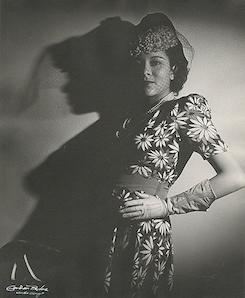
Gordon Parks Photography Gordon Parks, Marva Trotter Louis, Chicago, Illinois, 1941, gelatin silverish print, image: 24.13 × twenty cm (ix 1/2 × 7 7/8 in.), canvass: 25.4 × 20.64 cm (10 × 8 1/eight in.), The Gordon Parks Foundation, GP04581. Courtesy of and copyright The Gordon Parks Foundation
Early in his career, Parks found success equally a manner and portrait photographer. Marva Trotter Louis, socialite, fashion designer, and married woman of famous heavyweight boxing champion Joe Louis, was an early supporter of Parks. She was one of many people who encouraged him to move to Chicago in the early 1940s.
Here, Parks demonstrates the power of fashion, pose, gaze, and lighting as tools to both convey the personality of the subject as well equally make a captivating image. What do you notice first about Marva Trotter Louis? Observe her vesture: floral clothes, long gloves, lid, and veil. Await at her pose: relaxed, turned torso; hand on hip; and a gaze which directly meets our own eyes. What do these elements say about her? Dramatic lighting casts only one side of her torso in light; a night shadow in profile dominates the left side of the image. Why might Parks have arranged his composition this way?
Discuss how this image either challenges or reinforces your notions about race, gender, class, and power. How might this portrait have been perceived in 1941, the twelvemonth it was taken?
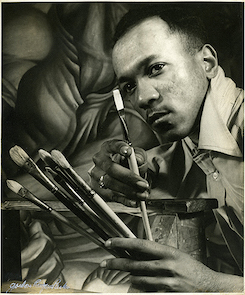
Gordon Parks Photography Gordon Parks, Charles White in forepart of his landscape "Chaos of the American Negro," 1941, gelatin argent print, epitome: 24 × 19.viii cm (9 1/ii × vii 13/sixteen in.), framed: 25.three × xx.two cm (9 xv/xvi × 7 fifteen/16 in.), Charles White Archives. Courtesy of and copyright The Gordon Parks Foundation
Parks moved to Chicago in 1941 and became affiliated with the South Side Customs Fine art Center, where he had a studio and darkroom. He developed relationships with a number of artists living and working in Chicago, including Charles White. White encouraged Parks, who was primarily shooting portraits, to have his camera into the streets and document the poverty he found there.
With his own tools in hand, White is featured in front end of his mural, Chaos of the American Negro. What strategies does Parks use in his limerick to communicate his respect for this artist? Compare this portrait with Parks'southward Self-Portrait also taken in 1941 (Slide 1). What similarities and differences do y'all discover?
Learn more nearly Charles White
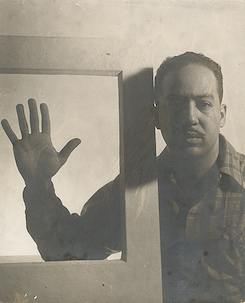
Gordon Parks Photography Gordon Parks,Langston Hughes, Chicago, December 1941, gelatin silvery impress, printed later, Corcoran Collection (The Gordon Parks Collection), 2016.117.102
As a leader of the Harlem Renaissance, Langston Hughes addressed important racial bug of the day through his verse, essays, and plays. His work inspired many African American artists, including Gordon Parks. Parks had moved to Chicago in 1941, and through his work with the S Side Community Art Middle had further developed the psychological content of his portraits.
The frame-within-a-frame composition of this portrait strikes a playful note, counterbalanced past Hughes'south sober, contemplative expression. Is this a portrait of Hughes or his hand? Physically separated from the rest of his body by the frame, his hand and arm take on a special prominence in the photo, suggesting Hughes's power as a writer.
Parks took this photograph just a couple of weeks subsequently the Japanese attack on Pearl Harbor, which brought the Us into World War II.
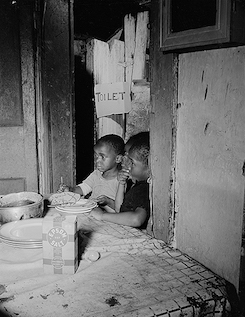
Gordon Parks Photography Gordon Parks, Washington, D.C. Three children waiting in the kitchen while their female parent prepares the evening meal. June 1942, gelatin silver print, sheet: 23.7 × 18.7 cm (9 5/16 × 7 three/viii in.), mount: 29 × 24 cm (eleven 7/16 × 9 7/16 in.), Prints and Photographs Partition, Library of Congress, Washington, D.C.
This is one of many photographs that Parks made in Washington while working for the Farm Security Assistants (FSA), a government agency. Roy Stryker, the head of the FSA's Historical Section, encouraged Parks to expect closely at photographs by other agency photographers before offset his own work. The subject area and carefully arranged composition of this photograph demonstrate the influence of that enquiry. Parks uses strong lighting to illuminate a dark, dirty interior with 3 immature children sitting underneath a handwritten sign indicating the bathroom behind them. In the foreground is a box of Epsom salt, perhaps a nod to the daily manual labor performed by the unseen adults in the house. The photograph is documentary in nature, just likewise highly manipulated and evocative.
Parks included captions with his photographs meant to provide groundwork information. The explanation states that the three subjects are waiting for their female parent to prepare dinner. How does this additional data help you lot read the epitome?
If you lot could give this photograph a championship (instead of a explanation), what would it exist?
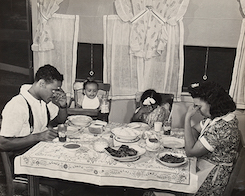
Gordon Parks Photography Gordon Parks, Anacostia, D.C. Frederick Douglass Housing Project. A family unit says grace before the evening meal. June 1942, gelatin silver impress, epitome: 19.3 × 24 cm (7 5/viii × 9 vii/16 in.), canvass: twenty.6 × 25.two cm (viii 1/viii × 9 15/16 in.), The Museum of Fine Arts, Houston, Museum purchase funded by Mrs. Clare A. Glassell
In 1941 and 1942, under the auspices of the Federal Public Housing Authority and the Alley Dwelling Authority (after renamed the National Capital Housing Authority), new public housing, such as the Frederick Douglass Dwellings in the Anacostia neighborhood of Washington, DC, was erected for black defense workers. At this time housing, theaters, restaurants, and many shops in the nation's majuscule were segregated. Parks was assigned to cover life in the housing project.
What tin we learn most this family unit from looking at this photograph? Why might the government have assigned a photographer to document life at this housing projection?
Consider that this picture was taken just months after the attack on Pearl Harbor on December 7, 1941, when the American authorities was actively preparing for state of war. Blackness Americans sought ways to support the war endeavor by enlisting in the military or working in defense industries, just oftentimes faced discrimination in their attempts to do then. Government-produced images such as this i offered hope for the future by demonstrating that life was getting meliorate for African Americans, an idealistic representation of the lived experience at the time.
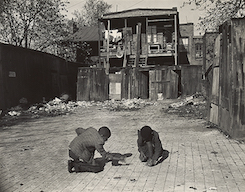
Gordon Parks Photography Gordon Parks, Washington (southwest section), D.C. Ii Negro boys shooting marbles in front of their dwelling. November 1942, gelatin silver print, paradigm: 9.2 × 11.7 cm (three 5/8 × 4 five/viii in.), sheet: 10 × 12.4 cm (3 15/16 × 4 7/eight in.), The Museum of Fine Arts, Houston, Museum buy funded by the Mundy Companies. Courtesy of and copyright The Gordon Parks Foundation
In the foreground of this photograph, ii young boys are engaged in play. The caption indicates that the run-downwards structure in the alley behind them, surrounded by trash and urban squalor, is their home. The boys, and then immersed in their game, seem unaware of their surroundings too as the photographer capturing this moment.
What does this photo tell you lot virtually the living conditions in Washington, DC, in 1942? What details in the photograph support your conclusions? Imagine you are a government official seeing this photo for the commencement time. Does it inspire you to take action? Why or why not? Support your thinking with details from the photograph.
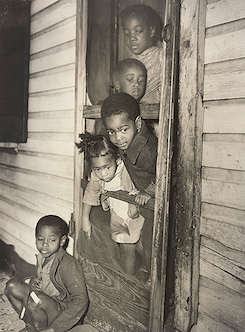
Gordon Parks Photography Gordon Parks, Washington (southwest department), D.C. Negro children in the forepart door of their home. November 1942, gelatin silver print, 33.66 × 24.77 cm (13 1/4 × 9 3/4 in.), Photographs and Prints Division, Schomburg Center for Inquiry in Black Culture, The New York Public Library, Astor, Lenox and Tilden Foundations
What has brought these five children to the front door of their home? Why has Parks chosen to photograph them in detail?
Parks gives us petty visual information to answer those questions. Instead, he offers us a moment to contemplate each of these children individually. What must their lives be like? What do their expressions and crowded arrangement past the door tell us about their connections as family? Parks had a detail sensitivity to capturing the spirit, hope, and humanity of young people in urban and rural settings.

Gordon Parks Photography Gordon Parks, Washington, D.C. Regime charwoman cleaning after regular working hours. July 1942, gelatin silverish impress, 35.56 × 27.94 cm (14 × 11 in.), Photographs and Prints Division, Schomburg Center for Research in Black Civilization, The New York Public Library, Astor, Lenox and Tilden Foundations
As ane of Parks's showtime assignments for the Farm Security Administration (FSA), he interviewed Ella Watson, who was cleaning offices at the Section of Agriculture, where the FSA was housed. He learned of her story of hardship and with her permission photographed her not only at work, but at home, with her family, and in her community. It was from this serial of approximately 85 images that Parks produced one his nigh iconic works, Washington, D.C. Government charwoman (American Gothic). The additional photographs in the series offer a multilayered presentation of Ella Watson's life. Many of the images reverberate the oppression and hardship she, like Parks, experienced in Washington, DC, but they also show moments of spirituality, love, and hope.
In this photo, Parks shows Ella Watson lonely, cleaning 1 of the many government offices. The harsh light focused on one point on the floor casts Watson into the shadows of the room, hinting at the invisibility of her work. Consider the role of calorie-free in this photo and compare it to Parks's portrait of Marva Trotter Louis.
What can nosotros acquire almost Ella Watson's professional and personal life from this photograph?
Learn more than well-nigh Washington, D.C. Government charwoman (American Gothic)
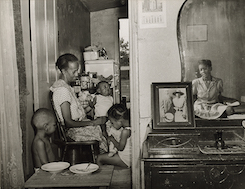
Gordon Parks Photography Gordon Parks,Washington, D.C. Mrs. Ella Watson, a authorities charwoman, with 3 grandchildren and her adopted daugther, July 1942, gelatin silver print, printed later, Corcoran Drove (The Gordon Parks Collection), 2016.117.106
Equally i of Parks'due south first assignments for the Farm Security Administration (FSA), he interviewed Ella Watson, who was cleaning offices at the Department of Agriculture, where the FSA was housed. He learned of her story of hardship and with her permission photographed her not only at work, but at abode, with her family, and in her customs. It was from this series of approximately 85 images that Parks produced one his most iconic works, Washington, D.C. Government charwoman (American Gothic). The boosted photographs in the series offering a multilayered presentation of Ella Watson'south life. Many of the images reflect the oppression and hardship she, like Parks, experienced in Washington, DC, but they also show moments of spirituality, love, and promise.
This is an image of Watson at habitation with her family. We glimpse her adopted daughter, Loretta, in the reflection of the mirror (on the right), seemingly contemplating the photograph of Watson's parents, also visible to us. Watson is surrounded by her grandchildren in the kitchen, perchance enjoying some time together afterwards dinner. Four generations are included in this photograph, demonstrating the importance of Watson'southward extended family.
What can nosotros acquire about Ella Watson's professional and personal life from this photograph?
Acquire more nearly Washington, D.C. Government charwoman (American Gothic)
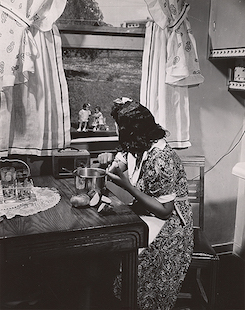
Gordon Parks Photography Gordon Parks, Anacostia, D.C. Frederick Douglass housing project. Mother watching her children as she prepares the evening meal. June 1942, gelatin silver print, 25.four × 20.three cm (ten × 8 in.), Photography Collection, Miriam and Ira D. Wallach Segmentation of Art, Prints and Photographs, The New York Public Library, Astor, Lenox and Tilden Foundations. Courtesy of and copyright The Gordon Parks Foundation
Compare this photo with the i of Ella Watson similarly sitting by an open window, both taken by Parks in 1942 in Washington, DC. What details practise y'all notice that aid to tell each woman's story? Why do you lot remember he has u.s.a. looking at the backs of their heads? Do you consider these works to be portraits? Why or why not?
What is Parks maybe communicating almost race and gender in 1940s America?
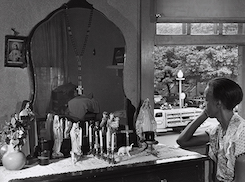
Gordon Parks Photography Gordon Parks,Washington, D.C., Mrs. Ella Watson, a Regime Charwoman, July 1942, gelatin silver print, printed 1960s, Gift of Julia J. Norrell, 2015.119.1
Compare this photograph with the one of a female parent in the Frederick Douglass housing project similarly sitting past an open window, both taken by Parks in 1942 in Washington, DC. What details do yous notice that assist to tell each adult female's story? Why do you lot call up he has us looking at the backs of their heads? Do you consider these works to be portraits? Why or why not?
What is Parks maybe communicating about race and gender in 1940s America?
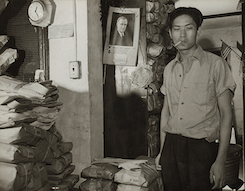
Gordon Parks Photography Gordon Parks, Washington, D.C. Johnnie Lew, possessor of the laundry nether the apartment of Mrs. Ella Watson, a government charwoman, August 1942, gelatin silver print, canvass: 18.2 × 23.3 cm (7 3/16 × 9 3/16 in.), mount: 24.1 × 29 cm (9 ane/ii × eleven vii/sixteen in.), Prints and Photographs Sectionalisation, Library of Congress, Washington, D.C.
As the caption indicates, Parks took this photograph every bit function of his piece of work documenting Ella Watson'due south life. This photograph offers a glimpse of the diversity of people who contributed to life and labor in and around Washington, DC. It is incommunicable to ignore that the subject, Johnnie Lew, is flanked by a movie of 32nd President Franklin Delano Roosevelt (over his right shoulder) and an American flag (which waves above his left shoulder).
How does this paradigm contribute to the story of labor in the Us?
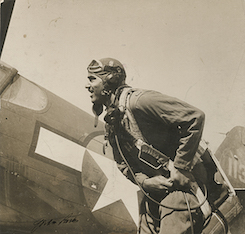
Gordon Parks Photography Gordon Parks, Lt. George Knox. 332nd Fighter Grouping grooming at Selfridge Field, Michigan, October 1943, gelatin silver print mounted on board with caption, prototype: 25.four × 26.35 cm (10 × 10 iii/viii in.), sheet: 27.31 × 26.35 cm (10 iii/4 × x three/8 in.), The Gordon Parks Foundation, GP02596. Courtesy of and copyright The Gordon Parks Foundation
In 1943, the increasingly unpopular Farm Security Administration (FSA) was abolished, pieces of which were and so absorbed into the Office of State of war Data (OWI). Before the FSA closed though, Parks was selected to transfer to the OWI, which he did in October 1942. He was assigned as a war correspondent to cover the 332nd Fighter Group, the kickoff regiment of black pilots, who were training nigh Detroit, Michigan. Parks's attempts to travel with the pilots for their commencement deployment abroad were continually thwarted by officials in the federal government, some of whom were not supportive of black pilots receiving such publicity.
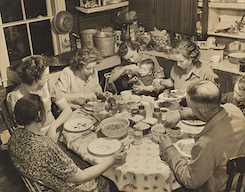
Gordon Parks Photography Gordon Parks,Dinner Fourth dimension at Mr. Hercules Brown'southward Home, Somerville, Maine, February 1944, gelatin silver print, printed later, Corcoran Collection (The Gordon Parks Collection), 2016.117.128
Gordon Parks took this photo while on assignment for the Standard Oil Company (New Bailiwick of jersey), a corporation suffering a massive public relations crisis related to a rubber shortage that threatened the country'south power to fight in Globe War 2. Role of Parks's assignment was to represent how the oil industry positively impacted life in the Us. Parks spent eight days with the Dark-brown family, pictured here sharing a family unit meal.
Wait closely at who is gathered around the table. Hercules Brown sits with his wife, 3 daughters, and grandson. His son-in-law is abroad fighting in the war. What can you learn nearly this family based on what y'all meet in the photograph? Discover how nosotros, as the viewer, seem to be looking downwards at the tabular array. Where do you think Parks was when he took this picture?
Compare with this paradigm with Anacostia, D.C. Frederick Douglass Housing Project.
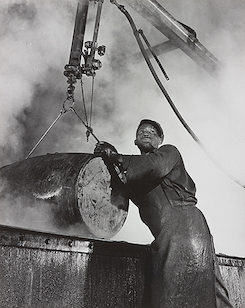
Gordon Parks Photography Gordon Parks, Pittsburgh, Pa. The cooper'southward establish at the Penola, Inc. grease plant, where large drums and containers are reconditioned. March 1944, gelatin silverish print, sheet: 23.nine × xix.one cm (9 vii/16 × vii 1/two in.), mount: 29 × 24 cm (11 7/16 × nine vii/16 in.), Prints and Photographs Sectionalisation, Library of Congress, Washington, D.C. Courtesy of and copyright The Gordon Parks Foundation
Employed by Penola, Inc., this anonymous African American worker toils to clean grease barrels by dipping them in humid lye. The simply man presence in a landscape of steam and steel, Parks uses dramatic lighting and a low angle to present him every bit a hero of industry. Agreement that his efforts were i part of an intricate system to supply essential lubricants to the military fighting overseas elevates him to the status of American hero, peradventure.
Parks wrote to Roy Stryker from Pittsburgh: "Photographing the grease plant at Pittsburgh was a pretty nasty chore. Information technology was nasty considering in every edifice and on every floor grease was underfoot. The interiors in the older buildings were extremely nighttime and absorbed plenty of low-cal, so it was necessary to apply long extensions and many bulbs. The extensions throughout the day were covered with grease….I might add together that a mean solar day at the grease plant leaves one with an enormous appetite."
Is this an image of American progress? Why or why not?
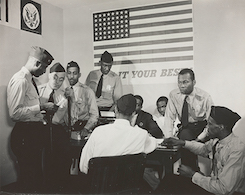
Gordon Parks Photography Gordon Parks, Washington, D.C. Auxiliary police at a weekly meeting, July 1942, gelatin silverish print, twenty.32 × 25.4 cm (8 × ten in.), Photographs and Prints Division, Schomburg Middle for Research in Black Culture, The New York Public Library, Astor, Lenox and Tilden Foundations
In 1942, Washington, DC, was still a segregated urban center. This meant that civilian defense activities, such as this group of auxiliary police (reserves who could exist called up in an emergency), were too segregated. Serious, uniformed men gather around their teacher confronting the backdrop of a large American flag and the motto "GIVE IT YOUR BEST." We accept every reason to believe they are doing just that.
This posed photo fabricated a instance for the kind of patriotism that included efforts by all Americans, regardless of race, to assist the state fight and win World War II.
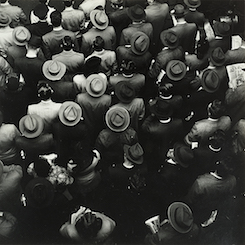
Gordon Parks Photography Gordon Parks,Ferry gunkhole from Staten Island to Manhattan, carrying early morn commuters, New York City, November 1946, gelatin argent print, printed later on, Corcoran Drove (The Gordon Parks Collection), 2016.117.129
Given its reliance on oil and lubricants, transportation was an important theme for the documentary photographers at Standard Oil Company (New Jersey). New York Harbor, where crowds of commuters made their fashion to Manhattan on the Staten Isle Ferry, represented the epicenter of this thought.
Consider the perspective in this photograph: Where is the photographer standing to have this picture? What does this photograph tell us about the nature of work in the United states? Who is present? Who is missing?

Gordon Parks Photography Gordon Parks, Untitled, Harlem, New York, 1947, gelatin silverish print, epitome: 17.78 × 17.46 cm (seven × 6 7/8 in.), sail: twenty.32 × 18.42 cm (eight × vii i/4 in.), The Gordon Parks Foundation, GP04135. Courtesy of and copyright The Gordon Parks Foundation
Here, Parks tackles issues of race in a visibly bold manner, reminiscent of his work Washington, D.C. Government charwoman (American Gothic).
Parks took this picture on assignment for Ebony magazine in 1947 for an commodity chosen, "Problem Kids: New Harlem clinic rescues ghetto youth from emotional brusk circuit." The commodity featured the work of psychiatrists Mamie and Kenneth Clark, whose "doll exam" enquiry investigated issues of segregation and self-esteem in black children. African American children in segregated schools were shown a black doll and a white doll and and then asked to choose ane. The majority picked the white doll, indicating that segregation impacted the children's feelings of self-worth. Their research, while non wholly scientific, was used in school desegregation lawsuits including Brown v. Board of Pedagogy (1954).
Imagine yous are the editor of Ebony mag. Would y'all have chosen to include this image in your story? Why or why not?
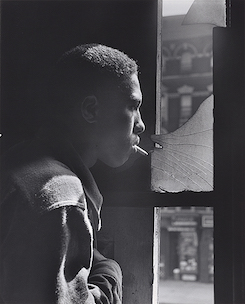
Gordon Parks Photography Gordon Parks,Trapped in abandoned edifice by a rival gang on street, Red Jackson ponders his side by side motion, 1948, gelatin silvery print, Corcoran Collection (The Gordon Parks Collection), 2015.nineteen.4605
On assignment for Life magazine, Parks followed Leonard "Ruby" Jackson, a 17-year-old Harlem gang leader. Parks's photo essay captured the violence and fear experienced past gang members and their families, and positioned him as an important documentary lensman. A twelvemonth later, Parks would become the start African American to be named staff lensman at Life. 40 years after, Parks ran into Ruby-red Jackson, who suggested, "You know, y'all and me could become back up to Harlem together and salvage some of those kids upwards there. I'm e'er request myself nearly how I got into so much trouble" (Gordon Parks, One-half Past Fall: A Retrospective [Boston, 1999], 84).
This photograph does not directly depict the danger associated with gang violence. Jackson does not confront the camera, yet the photograph offers close, most intimate, access to the subject. It invites usa to consider what he might exist thinking, seeing, or feeling. What role might these photographs play in a larger essay on gang violence? Exercise they offer hope? Describe how the setting, details, and lighting in each photo inform your opinion.
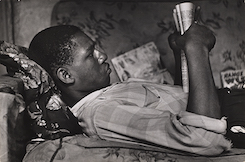
Gordon Parks Photography Gordon Parks, Ruddy's Younger Brother at Home, Harlem, 1948, gelatin argent impress, image: 22.1 × 33.iv cm (8 xi/sixteen × thirteen 1/8 in.), framed: 40.64 × l.8 cm (sixteen × xx in.), The Cleveland Museum of Fine art, Norman O. Stone and Ella A. Stone Memorial Fund, 2002.70
On assignment for Life magazine, Parks followed Leonard "Red" Jackson, a 17-twelvemonth-old Harlem gang leader. Parks's photo essay captured the violence and fright experienced past gang members and their families, and positioned him as an important documentary photographer. A yr later, Parks would go the outset African American to be named staff photographer at Life. Forty years later, Parks ran into Carmine Jackson, who suggested, "Yous know, you and me could become back up to Harlem together and save some of those kids up in that location. I'm always asking myself about how I got into so much problem" (Gordon Parks, Half Past Fall: A Retrospective [Boston, 1999], 84).
This photograph does not straight depict the danger associated with gang violence. Red Jackson's brother does not face the camera, yet the photograph offers close, almost intimate, access to the bailiwick. It invites us to consider what he might be thinking, seeing, or feeling. What role might these photographs play in a larger essay on gang violence? Practise they offer promise? Describe how the setting, details, and lighting in each photograph inform your opinion.
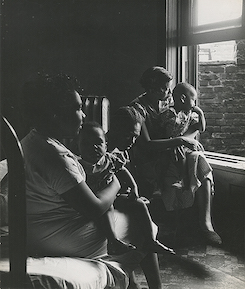
Gordon Parks Photography Gordon Parks, Tenement Dwellers, Chicago, 1950, gelatin silvery print, 32.vii × 27.62 cm (12 seven/8 × 10 7/8 in.), The Gordon Parks Foundation, GP04541. Courtesy of and copyright The Gordon Parks Foundation
In 1950, Life assigned Parks to produce a story most school segregation, then an increasingly important outcome in the nation'southward soapbox on civil rights. Parks chose to return to his hometown of Fort Scott, Kansas, to notice out what had become of his classmates from the segregated Plaza Schoolhouse. Part documentary, part nostalgia, this trip offered Parks a chance to reflect on how his understanding of a place changed with fourth dimension and how segregation afflicted the lives of his classmates and friends.
Compare the two photographs of Parks's quondam classmates. They concluded upwards in dissimilar cities, Chicago and Detroit respectively. What else is unlike about their life paths? How might they each represent the effects of segregation?
Imagine yous had the opportunity to return to your hometown thirty years from now. What might you expect to see? What would you photograph?
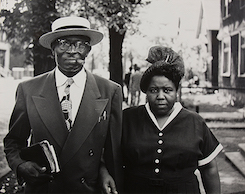
Gordon Parks Photography Gordon Parks, Husband and Wife on Sun Morning, Detroit, Michigan, 1950, gelatin silver print, 40.01 × 49.85 cm (xv iii/4 × nineteen 5/8 in.), The Gordon Parks Foundation, GP06161. Courtesy of and copyright The Gordon Parks Foundation
In 1950, Life assigned Parks to produce a story about schoolhouse segregation, then an increasingly of import issue in the nation's discourse on civil rights. Parks chose to return to his hometown of Fort Scott, Kansas, to discover out what had go of his classmates from the segregated Plaza School. Part documentary, part nostalgia, this trip offered Parks a run a risk to reflect on how his understanding of a place changed with time and how segregation affected the lives of his classmates and friends.
Compare the two photographs of Parks'due south former classmates. They ended up in different cities, Chicago and Detroit respectively. What else is unlike most their life paths? How might they each stand for the effects of segregation?
Imagine you had the opportunity to return to your hometown 30 years from now. What might you expect to meet? What would you photograph?
0 Response to "Hungarian National Art Gallery Painting Mother of Dead Son Comforted by Hand"
Post a Comment