How Can I Tell if My Baby Is Transverse
Sideways/Transverse
 "Transverse Lie" is a sideways position. The baby has his head to one of his female parent's sides and his bottom across her abdomen at her other side. This is normal before 26 weeks. By 29-30 weeks we await babies to be head-downwardly, or to at to the lowest degree be breech.Begin techniques if babe is non caput-down by 30-31 weeks. This article outlines easy ways to help a transverse baby move head-down and what to practise if self-intendance isn't enough.
Spinning Babies® highlights Dr. Carol Phillips, DC'due south amazingly successful technique,Forrard-leaning Inversion, to assist make room in the lower uterus for baby to move head-downwardly. Watch this excerpt from theSpinning Babies® Parent Classwhere Gail consults with a couple to help them turn their baby head-downward using the Forwards-leaning Inversion.Yous can purchase the full video to help prepare for birth.
Babe Positions
- Overview
- Inductive
- Posterior
- Breech
- Overview
- When is Breech an Issue?
- Belly Mapping® Breech
- Flip a Breech
- When Baby Flips Head Down
- Breech & Bicornuate Uterus
- Breech for Providers
- Belly Mapping®️ Method
- Head Downwardly is Not Enough
- Sideways/Transverse
- Asynclitism
- Other Fetal Positions
- Overview
- Oblique Lie
- Left Occiput Transverse
- Right Occiput Anterior
- Correct Occiput Posterior
- Right Occiput Transverse
- Face up Presentation
- Left Occiput Anterior
- OP Truths & Myths
- Anterior Placenta
- Twins
- Body Balancing
- After Infant Turns Head Downwardly
Parent Form
Read the 2017 business relationship of a full-term mother turning her transverse baby head-downwardly withForward-leaning Inversionson theSpinning Babies® Blog.
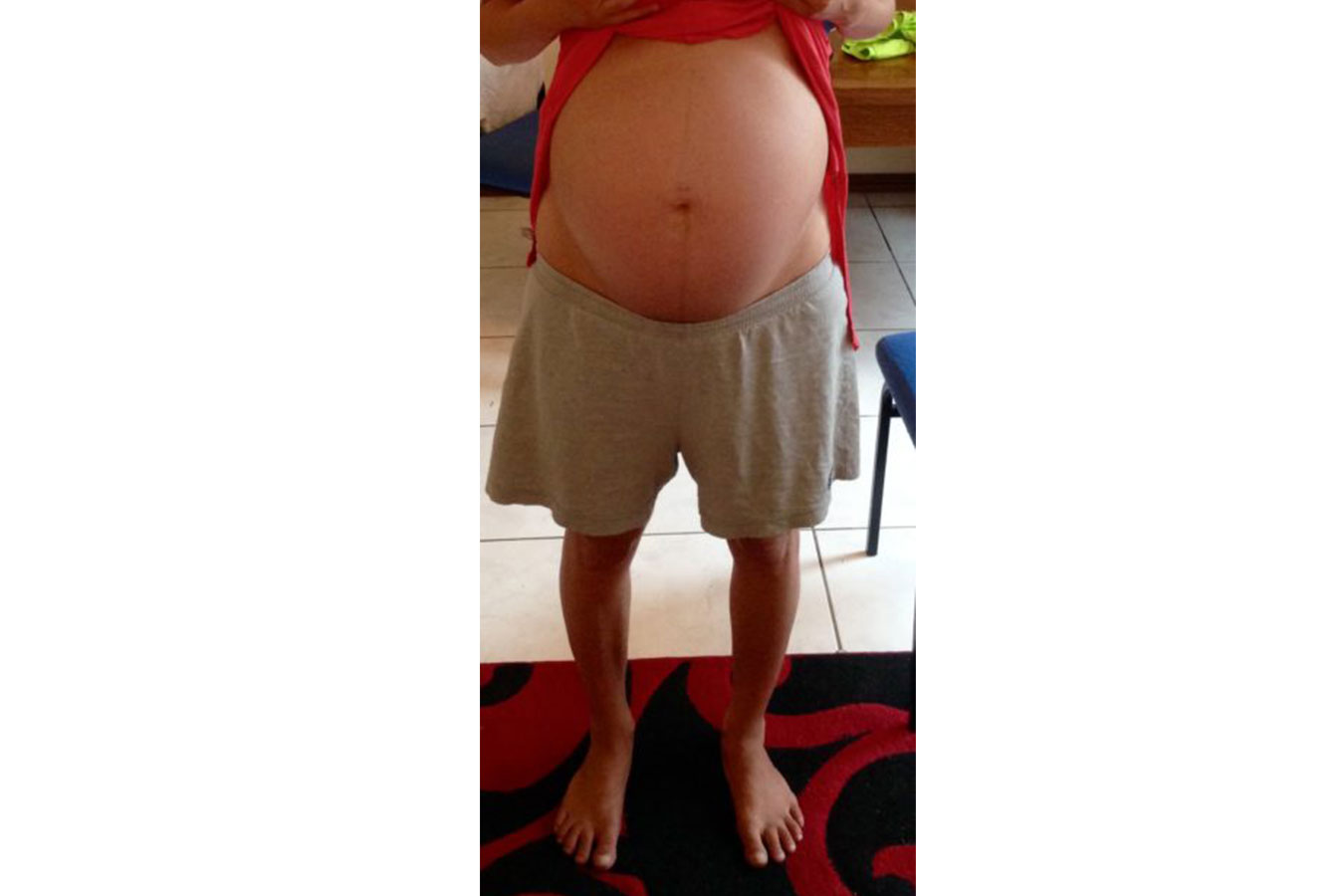
In this photo, baby is in a Transverse Lie (lying sideways in the womb). The head is on the female parent'southward left side and the bottom is on the upper-right. Baby's spine crosses the top and feet dangle toward the cervix. This mother's placenta was depression and taking upward infinite where baby would have put her head had there been room. Another transverse baby may have the head on the right and kick toward the front, etc.
NOTE: This transverse position is different than an occiput transverse (OT). In that position, the head, not the body, is transverse. The head is down, facing the female parent's hip.
Rae Bakery, a wonderful doula in Minneapolis, shares her story in this video:
Rae Baker'due south Story
Techniques to correct a transverse lie
Please check with your primary intendance provider and/or birth intendance providers to see if there is any medical reason for you not to be upside down for the inversions (e.g. risk of stroke considering your blood pressure is and then high, etc.). In that location are things a salubrious woman tin do to help a transverse,oblique, orbreech babyturn head-down. For a baby changing position oft (called an unstable prevarication), these techniques work very well.
"Big Turning Day" baby repositioning routine
- Use theForward-leaning Inversionoff the couch, as shown in thevideo, for 30-45 seconds, seven times in ONE twenty-four hours (not twenty-four hours after day!), nearly fifteen minutes to two hours autonomously. Follow two-three of the FLI this solar day with the Breech Tilt (side by side).
- TheBreech Tiltfor 5-10 minutes, ii-3 times a day (these two inversions accomplish 2 different things, so doing both may be important. Do them in this order 2-iii times a 24-hour interval until baby is caput-downward) Practise not slumber in bed this way.
- 2-iii times a twenty-four hour period, while baby is breech or transverse (after 32 weeks), practice theSide-lying Release
Other potentially helpful things:
- Stand on your head in a puddle of warm water, such as a backyard swimming pool or a therapeutic pool at a hospital or rehabilitation center. Some hotels volition let y'all join a swimmer'due south gild.
- Stabilize your pelvis, lengthen your pelvic floor in mid-pregnancy with anterior pelvic tilts and squatting (employ a squatty potty for passive squats while toileting).
- Habiliment a pregnancy belt AFTER baby is head-downwardly if you doubtable your uterine ligaments are too soft. The pregnancy belt gives a slight pressure to support a loose belly and also may relax a tight belly. Create the missing "gradient" of the abdomen with the pregnancy belt to help babe drib head-down into the pelvic brim. Find your type of belt and the right snugness for you lot.
- On the 3rd time and later each time y'all doBreech Tilt, you may place a very cold item, like frozen veggies wrapped in a thin dish towel (don't freeze your skin!), on your abdomen in the place that is BEHIND and ABOVE the baby'southward head. At the aforementioned time, identify a very warm item, similar a toasty rice sock, Beneath and IN FRONT OF babe's confront. We are hoping babe moves toward the warmth, so place the warmth betwixt the infant's face and the pubic bone. This helpful addition to other techniques is not likely to work just by itself. Inversions are recommended unless your caregiver says specifically that you have medical reasons not to do an inversion.
- Release your psoas muscles.
- After baby is head-downwardly, stop inversions for three days and continue walking each of these three days. Resume inversions I fourth dimension a solar day for 30 seconds, coming back up to kneeling later on.
- Constructive Rest Position. Each day, lay on the floor on your back for no more 10 minutes with your ankles resting on a chair. Your knees are bent to a 90-caste angle. Breathe slowly and securely from your belly. Come across your belly rising and fall like a sleeping toddler.
- At that place are several yoga extensions of the legs that help. They are oftentimes called hip openers and use a strap to extend into for counterbalance.
- A gentle stretch of the psoas can be done with you lying on your bed with your hips on the very edge. Bend ane knee and hold that leg up by your abdomen. Let the other leg gently stretch and hang beneath the edge of the bed. Information technology gently pulls on the muscle going over the front border of your pelvis on that side, just within of your hip. 3 minutes on one side, switch sides. 1x a day.
- Do not permit your psoas to be straight massaged. See world wide web.coreawareness.com
In general, for all positions that are not head down (besides persistently posterior babies):
- 30-34 weeks:Dailyandweekly activitiesand sitting on the forepart of your sitz bones may help some. About women need specific balancing exercises to bring a twist out of their lower uterine segment. Torso work is recommended if you can get proficient care where you live.
- 34-36 weeks: Spend the week working withmoxibustionon your lilliputian toes and doing thebalancing activities. Seek professional soft tissue from a chiropractor, osteopath, therapeutic massage therapist, or craniosacral therapist who may have the training for a fashion of gentle release. See this experienced person for three visits right in a row. Reschedule remaining visits to weekly, if you like, when baby drops head down, but don't spread your visits out until you have success.
- 36 weeks or more: If these things don't piece of work in three days, delight make an appointment with a chiropractor who is particularly trained in theWebster Techniqueand other pregnancy and pelvic issues, AND who is regularly adjusting meaning women. If the chiropractor's adjustments don't piece of work within 2-3 visits (try and get your appointments all within a week or two), then add ii visits with a myofascial release person who works with pregnant women. Did you have a day to do 7 Forward-leaning Inversions? Proceed doing theInversionandSide-lying Releaseon your ain, unless told not to by your chiropractor (I think it's worthwhile in general to practice both, so encounter if they have a specific reason not to in your case).
- 39 weeks: Why have acesareannow? (Alarm, opinion coming…) The reason may be for your surgical team'due south convenience. Why should your baby miss a few encephalon cells for the ease of scheduling? If you are healthy in other ways, give your baby some other week or two. There are risks in both choices,so choose carefully. Early surgery has unavoidable side effects that will happen, and waiting has theoretical side effects that may happen. Babies have been known to plow head-down even at 40 weeks with 7 Forward-leaning Inversions.
Techniques tin be adapted to the needs of the pregnant person.
Techniques to correct a transverse lie when the belly seems loose
For those who have given birth before — and for a few first-timers — the trouble may not exist with tightness, but rather with looseness (though a twist in the cervical ligaments is the usual reason and the usual solution is still Forward-leaning Inversion). The idea is that once the baby is head downward, back up the abdomen with a pregnancy belt and possibly a rolled paw towel (Brust pad) so that the baby stays head down and in a vertical lie. Amanual versionmay too be successful in helping babe get caput down. When ligaments or abdominal muscles are not time success is more likely.Anterior placentamay be a reason not to do a manual version. Precede your manual version with the "Big Turning Day" routine in a higher place. Add a Forrad-leaning Inversion in the hour earlier the procedure. When successful, await three days, walk a lot during the next three days and don't go upside downwardly until walking settles baby a bit lower. Then resume ane FLI a day, just one. Run into how you feel near doing one FLI in labor for good mensurate, if you feel able. I really remember it benefits.
Using a pregnancy belt for transverse lie
When the lower belly is loose, equally with a pendulous uterus, add a pregnancy belt to create an improved slope to the lower uterine segment. A pregnancy belt helps the uterine ligaments hold the uterus upright and so the baby can get into an upright position. For the mom with loose ligaments, I would propose wearing a pregnancy belt in the fifth calendar month through to labor, and for very loose moms with a pendulous womb, and then wearing the belt through pushing the baby out is safest. Women with tight ligaments tin can wear a pregnancy belt likewise for the support. Information technology is really quite relaxing.
Professional aid for a transverse lie
If the womb seems tight effectually the baby in pregnancy (chronically, not but during Braxton-Hicks contractions), thenprofessional helpis needed. Bodywork tin can correct the length of the uterine ligaments so that they are all symmetrical. Chiropractic adjustments align the pelvic basic so the joints are symmetrical and this, in plough, helps the uterine ligaments become symmetrical. Doing both the bony adjustments and the soft tissue piece of work is the most time-efficient and successful if the female parent's inversions don't piece of work in 3-4 days.
- Some chiropractors and craniosacral therapists know how to practice a myofascial release of the round and broad ligaments. Certainly, a myofascial massage worker can do this.
- Maya abdominal massage is some other fantabulous option for symmetry.
- Acupuncture, constructive for fetal positioning, especially when done by an experienced professional.
- Moxibustion, heating the acupuncture points with a stick of mugwort incense, can exist washed at dwelling house inexpensively. Best results from twenty minutes a twenty-four hours during the 34 and 35th calendar week.
- Chiropractic adjustments to align the cervix and pelvis, including SI joints and Symphysis Pubis; Webster; Logan Basic; and other areas every bit individually needed.
- Myofascial, Continuing Sacral Release (formerly known every bit a buckled sacral release) and diaphragmatic release (Abdominal Release)
- Homeopathy, Pulsatilla, or other remedies can help with malposition. See a professional for the best results.
This piece of work is specifically for your pelvis, neck, and soft tissues (sacral fascia, circular and broad ligaments of the uterus, cervical ligaments and sacrotuberous ligament). Call back the time to hire bodywork for transverse babies would exist between 32 weeks and birth. The sooner the amend! Begin at or after the middle of the 7th calendar month. If you lot want to attempt things at abode in weeks 32 to 34 that seems reasonable, though if baby is big, and/or mom is tight I would start gettingprofessional helpearlier. Starting in mid-pregnancy isn't too early. Next yr at this time, would you like to look dorsum and feel satisfied that you lot did all that yous could do at this time in your life?
What'south the problem with a transverse prevarication?
The baby who is lying sideways cannot exist born vaginally. The baby has to get vertical to fit through the pelvis. A breech or vertex (head down) baby tin usually fit. Labor contractions cannot bring this babe through the pelvis. Perhaps the arm or umbilical string would come through the pelvis, but the shoulder and ribs would cease at the acme of the pelvis. Let'due south help this baby move to a head-downward position so that a cesarean can be avoided.
When is transverse lie a problem?
It is normal for a infant to be transverse in the first and second trimester. Nosotros hope that the infant is in a vertical position between 26 and 31 weeks gestation. Thebreech positionis quite normal when establish between 26 and 31 weeks gestation. A message from a mother:
I am 26 weeks pregnant with my 3rd kid. I has my 1st child via c-section, (normal positioning, distressed baby) and my 2nd viaVBAC. I was told yesterday that my infant is currently transverse and I am very concerned that I volition not be able to have another VBAC due to this….
Gail's Respond:
Dear [Ane], Delight know that it is perfectly normal at 26 weeks for your baby to be transverse! Delight don't worry. Your baby is very likely to be caput downwards shortly–but y'all can all the same Do theForward-leaning Inversioneach solar day! Nigh babies are head down past 28-xxx weeks gestation while a few babies wait to settle head downward until 31-34 weeks. Fewer babies still transverse at 34-36 weeks can get head down on their own. After 30 weeks, it may exist practiced to do daily exercises to help your baby get head down. If you lot healthy plenty to practise inversions, please attempt the 5-7 Forrard-leaning Inversions for One solar day, and do Side-lying Release after the beginning 2-iii to add maximum room for the next three-iv to work better. Late in pregnancy information technology becomes more hard to aid the transverse baby to get head down.
"Why is my baby transverse?"
At Spinning Babies®, the basic idea is that babies go into the best position they tin given the space they are in. Sometimes a placenta is below the babe blocking the baby from getting caput downwards at the end of pregnancy. The2d twinsometimes waits in a transverse position until after the first twin is born; so the second twin drops into place, caput down, and is born soon afterward. Simply often, there is a simple need for rest, the1st Principle of Spinning Babies℠.
Not every uterus is lined up vertically, usually because of an blow or even a habit that has tipped or twisted the uterus. This may have happened many years agone. Simply until a series of exercises or bodywork has "lifted" the uterus back into place, the uterus remains where it "vicious." This might be the reason gravity hasn't been able to bring the babe head down, either that the lower uterus is tight with a twist or too loose to support the babe vertically.
When the infant has been transverse in the last trimester, information technology may exist because uterine ligaments or pelvic flooring muscles take a twist. The womb seems shaped for a transverse infant. The babe will stay transverse when the pelvic inlet (brim) is non symmetrical or the lower uterine segment (the lower part of the womb where the head would normally settle) is non symmetrical. Crossing our legs, property toddlers on our favorite hip, a fall, etc. can put a twist in the lower uterine segment.
Gravity helps, but in that location is less room to navigate the womb. First-time mothers and women with tight, sturdy musculature, spasming ligaments or tight fascia can practise exercises or have bodywork (or both) to loosen these soft tissues and allow more fetal motion. Women who have birthed before, and who accept loose soft tissues (this includes a few offset-time mothers, but almost experienced mothers), may really need to prop their wombs and abdomens up to let the baby get head downwardly!
After 32-34 weeks, I am quite concerned to find a transverse baby – except when the infant was breech recently and is now in the process of flipping to head down. The breech-to-caput-down process may have 3 days (but is ofttimes iii minutes!) and a mother or provider may find the babe in a transverse position in the midst of the change. Usually, the mother knows the baby is "on the move." (I hope she keeps "balancing" to avoid her muscles reverting to the erstwhile muscle shape that put the baby into a transverse position).
Breech lie or transverse prevarication?
The transverse lie position is sometimes loosely called breech. This seems more common amidst ultrasound technicians. Midwives and doctors exercise not utilise these terms interchangeably. They are not the same. Thebreech babylies vertically, the transverse prevarication infant lies horizontally. The breech infant has an easier time getting head-down than the baby who has been transverse into the third trimester. An interesting bespeak is that a breech baby may move to the transverse lie for a couple of days before finishing the flip to head-down. If your transverse baby was just recently breech wait a couple of days earlier worrying, and proceed upwardly the techniques you are using to help baby into a head-down position.
A head-down variation: Ane woman may have had weak uterine ligaments in spite of being a strong, able-bodied woman. Perhaps the jolting stops during soccer affected her uterine ligaments in this style. Her kickoff infant was caput-down, but with the picayune bottom resting on her right hip. The baby was folded at the baby's waist in this way for the entire third trimester. I wondered how information technology would touch nativity. I suggested a pregnancy belt but the mother wasn't concerned. Her labor avant-garde beautifully and the infant came downwardly through the pelvis perfectly. I was happy to see how well birth works in a fetal position variation that I had never noted before in a outset-time mother. The baby had seemed somewhat in a transverse prevarication, simply since the head was in the pelvis, wasn't. The mother used agile labor positions and free motility, instinctively moving with her labor and the baby came down well.
A breech variation: Another woman's second baby wasbreechwith the bottom at the archway to her pelvis. Her uterus leaned far to the left, visible from behind her. Labor began on its ain, and she hoped for vaginal breech nascency. However, labor contractions didn't stay consistent and the uterus connected leaning to the left. The uterus couldn't aim the baby into the pelvis. The baby never descended and acesareanwas the simply safety option when labor wasn't able to progress. Could exercises and torso work have helped her to have a natural nativity? Peradventure they could have. These techniques might work in labor, merely in this example, may have been needed weeks before. Her baby might accept even gotten head-downwardly. Her chiropractor didn't know the total myofascial/craniosacral release protocol for meaning women (Learn more at www.dynamicbodybalancing.com). What has worked for others: From a annotate on theForward-leaning Inversion video on Gail's blogpost:
Thanks SO much for posting this! For the past couple I've been a lot of hurting but I didn't know that all the pain was coming from my son being transverse. I knew he was lying similar that but I never knew it could crusade all the pain it was causing. I was even sent to Fifty&D to encounter if i was in preterm labor. At my follow-upward OB appt she told me that if he didn't move that A.) I'd be in pain until I went into labor and B.) It'd be a mandatory c-section. I'1000 merely 36 weeks forth and was missing tons of work along with slumber and just turning into a nasty adult female to be around in general. After leaving the OB's part and learning that this was the reason for all my hurting,I texted my doula who told me to look upwards your website. After learning that our son was in a "transverse lying position" I found the video of the lady doing the [Forward-leaning Inversion] and decided to try it off a bed. I was able to hold the pose for (30) seconds but I didn't think anything had happened. My hubby checked the baby'south position and sure enough he was in the perfect occipital posterior position! [! ok, one person's malposition is another person's perfect position!] It's been over (4) days now and he hasn't moved back so I'm praying we are safe. Cheers SO much for saving me all the pain of carrying him sideways and avoiding a c-section!! – The McGuire'due south, December 28, 2009 12:45 PM
Inversion is an first-class thing to do, but may non be enough on its own. If using the inversion doesn't work later on 3-four days, when you lot are 32 or more weeks pregnant, then I would suggest getting professional person torso work. See more about this lower down in this article, and see more fun things to help baby flip head down underBreech. Hither is my answer to a woman writing who is 34 weeks forth with a transverse baby:
Do you know how long your picayune girl has been lying transverse? Yous are doing theFrontwards-leaning Inversionsfor 30-seconds? You may also do theBreech TiltInversion for v-20 minutes, longer every bit you get used to them. After near 3-6 times (in 2-3 days), you lot might start putting a lightly wrapped cold pack on your upper uterus, above the baby's caput (not directly over information technology, just higher up it). At the same fourth dimension, putting a warm pack behind your baby's head and towards your pubic os. Close enough for the heat to radiate to the baby's head. I don't know which way your little one is facing, just I suppose it doesn't matter. The idea is that the baby feels that information technology is warmer towards your pubic os.Moxibustionis so helpful in weeks 34-35 and beyond, but especially these two weeks are more successful to go baby head down. Use in improver to other methods of helping baby go head down. Add myofascial release to the chiropractor'southward adjustments. Ask the chiropractor to add togetherWebster'sto both sides in 1 visit, if they would please. Craniosacral work can make chiropractic more effective and visa versa. Head stands in a warm puddle of water. Hanging from a yoga sling (ane minute) or an inversion table (ane infinitesimal). Learn torelease your psoas. Visit CoreAwareness.com with Liz Koch. A tight psoas may concur the baby'due south caput back above the brim to the side. Talking to your babe, likewise. Whether out loud or by journaling. Encounter what y'all can learn about your self this way, also. If your daughter has been transverse all along do everything you can, all of the above you lot tin can. If she was breech last week and transverse this week, she is likely to get head downward with less to do. But it sounds like she's been transverse a while. Very often this is from a soft tissue issue in the lower uterine segment which can be caused by torsion in the pelvis and the surroundingsoft tissues(ligaments, fascia, muscles etc.) Addressing these issues will probable let the baby to move into a head down position. Exceptions, if the placenta is beneath the baby covering the access to the cervical area. An unusual uterine shape, a partial septum or a coarse blocks the babe'due south attempts to get caput down. Ultrasound would reveal something as obvious as these. Ultrasound is unlikely to reveal a twist in the lower segment of the uterus which is 1 of the soft tissue issues I mean. Please permit me know if any of these or some other suggestion helps y'all. I will hope for the best and expect the best for yous and your baby. – Gail
A-K posted on the website:
I am 40 weeks pregnant with my 2d child (starting time one born naturally) and was told today by my OB that baby is at present transverse. This was as well confirmed by an ultrasound (at my terminal visit a week ago, infant was in the heads-down position and had been so for several weeks). I have been given three more days to see if the infant will plough earlier my doctor wants to schedule at C-section (at 40+iii). I have already visited a trained acupuncturist and am doing the inversions on your site to try to preclude this. I would just like to know:
- How common is it for a transverse position to appear so late in the pregnancy, and what are the odds of turning the baby back downwards?
- Which of the inversions tend to be the most effective at 40 weeks, given the more express room for the babe to move? The dr tried to externally manipulate the babe to motion downwards today but failed.
Thanks then much for a lovely website!
Gail writes (this version is edited):
A-K, I hear the surprise you are suddenly faced with. I will try and reply your questions. Why now, in late pregnancy? A baby will motion from a good or reasonable position to aposterior,breech,obliqueor transverse position in late pregnancy when at that place is:
- An existing reason, usually a twist in the lower uterus or other reason the area of the pelvic inlet is compressed or twisted. Remainder the area with body work andForward-leaning Inversionsand baby volition return to a caput down position.
- The baby will pull away from the pelvis (tailbone, sacrum) if something happened such equally a fall, twist, bear upon, or a significant emotional stress nigh parenting. It tin happen to any of united states of america.
- Some event may trigger an erstwhile injury. A long motorcar ride can be the culprit. If this is the example, addressing the trigger is likely to let the baby to settle back head downward chop-chop.
How many times practise you need to do the inversion? How quick tin babe become caput downwards over again? You run into the range of success in the comments to theFeb. ninth 2007 blog postfrom ane inversion, to three, to several. Information technology doesn't always work, but it seems to work often. What else could y'all do?Professional help: Myofascial release, chiropractic, and craniosacral therapy along with your acupuncture may increase chances of success. I can't hope, of form. But these are efficient ways to accost the crusade. Self assist: Begin with theRebozo Sifting, go to theForward-leaning Inversionand follow it with theBreech Tiltusing hot and cold pacs. Then I'd add aSide-lying Release. How ofttimes does a baby become transverse at the finish of pregnancy? Information technology is uncommon. All the same you are likely to get the babe caput downwards even in iii days with several short, Forward-leaning Inversions and addressing the soft tissue cause, assuming that something was, or became, twisted near your cervix or skirt. A twist in the cervical ligaments will twist the lower uterine segment where the babe would like to put his or her head. Depending on the amount of twist the baby may support and get transverse orbreech. This is fixable with the right body work for yous. Be kind to yourself as you try to take on this challenge. You are doing the best y'all tin can with a suddenly complex situation. Keep breathing and talking to your infant. Together you volition find your way to the other side of the transverse prevarication.
On January 12 I received this email:
Dear Gail, I plant your site very informative. This is my tertiary infant later on the starting time two normal deliveries. I've been having check ups for this babe, and since 38 weeks, babe was breech, few days later turned to right transverse lie, then over again turned to left transverse lie in my 38weeks 6days scan. I can feel her move upwards and downwards the left side of my belly, as the caput is prominent. Got a check upwardly scheduled for tomorrow. I want to know what my options are to have a normal delivery at this stage.
Gail writes:
Hi Tijitha, It may exist that your belly is loose, Jean Sutton suggests laying on your left side and while lying down, bind your abdomen tightly, then habiliment that chugalug for 24 hours. Let me know if this works, otherwisemy articlesays everything else. Whether your baby would exercise this spontaneously, I don't know, but don't think that information technology's as likely equally abreechflipping head downwardly.
Tajitha'south answer:
Honey Gail, Thank y'all for your prompt respond! I will try out the belt. When I tried an inversion today, the babe moved from the transverse lie to a breech. I am feeling her head nigh my ribcage. Could you comment on this? With best regards, Tijitha
Gail's reply:
Hi Tijitha, In my stance,breechis better than transverse and easier for the baby to flip head down from breech than from a long time in the transverse. If the baby moved that much with just iinversion, i think she will flip head down with a few more… unless there is quite a twist somewhere, sacrum or pelvic floor, or something, and more work may exist needed. In one case babe is caput down I suggest a brisk long walk followed by a pregnancy belt worn for a while! Until engagement perhaps. Wear the chugalug snug simply not tight. Enough to requite a slope to your abdomen and if you need to put a scroll of a face material vertically on the right side, tipped a little to fit in the area of the correct side, higher up the hip but likewise by the crease between the thigh and abdomen, but on your abdomen to reduce the area on your correct and encourage baby to stay head down and move to your left. However, if your pelvis is kleptomaniacal this won't piece of work long, you will take to have an aligning. Doing many inversions (xxx seconds) volition act a bit similar an adjustment and may or may non be plenty. Meet what 6 more practise in the adjacent 3 days if you tin. Merely, Tajitha, always do what you remember best. Y'all are the mama. -Gail
Just two days subsequently, January fourteen, I received Tajitha'south happy news:
Amen! Gail, my infant has turned head down! Praise God! I did cypher more than that one inversion than pray with faith! And am scheduled for an induction tomorrow morning. Will update you as soon as I become back to normal affairs after baby is built-in! God bless yous! Have a wonderful 24-hour interval! Honey, Tijitha
And later, on Jan. 18:
Honey Gail, I delivered my infant boy on 15.one.2011 through normal delivery. Give thanks y'all for all the support! Beloved, Tijitha
Gail:
Dear Tajitha, This is such a blessing! And unusual for 38+ weeks. Do y'all think the inversion may take influenced your baby to flip head down? What was the timing? Was it the morning later an inversion when you woke upwardly? When? May I share your story on my site?? It'south quite wonderful….
Tajitha's Reply, Feb. 2:
How are you lot? My baby has been keeping me busy. Oh yes! I would love to encourage other ladies who may be going through a similar situation. On the 13th [in the] forenoon I had done the inversion and on the 14th morning the infant had turned head down. Information technology was confirmed by a browse. Could you please mention that after I had done the inversion, I prayed earnestly with faith that God can turn the baby, and He did. When we pray with faith, God tin can work wonders!
Some other January substitution:
Hello, I was told yesterday at my 37 week appt that the baby was transverse with his head on my right side and bottom on my left. He seems to be lying with his head slightly lower then the butt. I have been doing inversion a few times since then hopefully it volition piece of work. How oftentimes does a baby turn without additional help ie. chiropractor or moxibustion? I slipped on some ice and fell on my left side Monday afternoon, could that have actually caused him to move from caput down? thank you so much, M
Gail'due south Reply:
Dear M, Yep, the fall may take been the crusade. Some babies volition flip caput downwardly, only the studies don't track whether mothers have had a previous fall, which can misconstrue the lower uterine segment via a twist in the sacrum or spasm in the ligaments. If y'all exercise nothing your baby may flip, if you lot practise something your baby may flip and may be more probable to be head downwards than if you do nothing. A year from now if you accept acesareanfor a transverse baby, will yous feel the all-time about the amount of exercises that you chose to do? If you notice a practitioner, like a chiropractor, become a recommendation from a birth grouping, doula, prenatal yoga teacher, midwife, or all of the above. You want someone who sees meaning women daily. They need to address your sacrum in both vertical and horizontal misalignments, as well as your symphysis. At that place is a test they tin do before they arrange your cervix to make sure a neck adjustment is safe for y'all. Be sure you are doing theFrontward-leaning Inversioncorrectly. You tin practise theBreech Tiltafterwards for 10 minutes. Ask your provider if there is any medical reason not to practice these inversions (rather than an opinion) in your instance. Let me know what you make up one's mind. Peace is an action, Gail Tully
From M:
Hi Gail, Cheers for getting back to me. Yes the baby was head down and I noticed that my abdomen seemed lower the solar day later the fall. I have an appointment tomorrow with a chiropractor who is trained in the Webster technique, so hopefully that will assistance. I have been doing inversion with my knees on the couch and resting my forearms on the floor. I will have my married man cheque to make sure that my lesser is lined up with my knees. So information technology is okay to practise both the inversion and the breech tilt? I thought you lot were supposed to practice one or the other. The doc did suggest doing a version [external cephalic version], I have an ultrasound scheduled for tomorrow to bank check fluids. I wanted to endeavor less invasive techniques first and then will do that if need be. Over again thanks and then much for your respond, G
[From Gail]
I agree with yous, [K], Do the body piece of work first,Websterand some sacral release (myofascial, come across if your Chiro is trained in it) etc. and that would help themanual cephalic versionbe more successful if you do decide to have it afterwards. (if the baby doesn't flip.) If your body work folks tin figure out how to put yous back to rights your infant should go head downwards in 48 hrs afterward the correction, if not sooner. Yes, y'all can do theForward-leaning Inversionfirst for 30 SECONDs and then theBreech Tiltfor 10-xx minutes. Tin can you do a series of 7 Forward-leaning Inversions tomorrow morning?? Peace…
[From 1000]
I did the 7 inversions and and then the breech tilt this morning. I also went to the Chiro, and at the ultrasound, he is head downward ? Now but to keep him that way for iii more weeks. Volition an inversion or 2 daily aid go along him down? Thank you so much for all your advice, I'll keep you updated as I am trying to take some otherVBACfor this one. M
[From Gail]
Yes, I practise suggest one inversion a day, but tin can you also walk about iii miles a twenty-four hour period for 2-3 days before resuming the inversion? I'm so happy you lot plant these techniques successful! Peace …
1 more than, July 12, 2011:
Hello Gail, I got your email off of thespinningbabies.comwebsite, so I hope y'all don't mind me emailing you asking advice. This is my tertiary baby, and I'thousand 35 weeks along. However, this is my first experience with the baby non being head down. He has been contently lying with his head in my right rib, and his feet in my LLQ for quite a long time now. I am terrified he won't plough for a natural delivery! I heard peachy things nigh your website, just the terminology confuses me to no end. I was wondering if you could maybe aid me effigy out some positions I could try to go him to flip! 1 I saw is with my legs on the couch and arms on the ground. How long exercise you stay in that position? I have 2 weeks left till my Dr. volition practice a [external cephalic] version, and I'm terrified of that. Plus, the success rate isn't that not bad. Anyways, sad for rambling and taking up your time. I hope you can help me! [name withheld]
Subsequently, another electronic mail from the same mother:
I had 1 of my friends show me how the site worked … and between the positions and the acupuncture, he flipped!!! Now hopefully he doesn't flip dorsum. Simply cheers for your response! I really capeesh it:) And no, I didn't do the [external cephalic] version. I opted out of it. I didn't like the risks. I just decided to endeavor the acupuncture, all-4'due south, and the burrow affair on your website.:) [Forwards-leaning Inversion]
Questions I'd ask a woman who is scheduled for a cesarean for a transverse prevarication or breech presentation:
Is convenience the most of import thing to schedule your baby'due south birth around? If non, you might ask for a postponement to 41-42 weeks gestation. Yous'd be taking additional responsibility for your nativity. And giving boosted benefits to your babe, if you and your baby are healthy, that is. And so this is something to inquiry so to discuss with your md. Waiting for spontaneous labor has benefits equally well as risks. Y'all should know about both to make an informed decision.
I practise abet for waiting for spontaneous labor in full general. However, yous are the Mama, and you get to determine. Information technology's not wrong to schedule acesareanfor malposition specially after 41 weeks or at any appropriate fourth dimension (if mom or baby really are ill; or baby had InterUterine Growth Retardation. IUGR is not mental retardation, but small for dates due to poor placental apportionment or other serious reason). Some women would face up serious hardship or chance waiting for labor. Simply most women and babies would receive benefits when letting labor begin and then going right in and having the cesarean. There is a risk of prolapsed cord. In that location is a benefit of improved breathing and encephalon chemicals for life outside the womb. It'south non an like shooting fish in a barrel conclusion, so it can't be made for you.
Whatever yous decide is the best decision for the situation at hand.
How Can I Tell if My Baby Is Transverse
Source: https://www.spinningbabies.com/pregnancy-birth/baby-position/sideways-transverse/
0 Response to "How Can I Tell if My Baby Is Transverse"
Post a Comment